
What Does a Mortgage Broker Look at Before Recommending a Lender?
The right mortgage isn’t just about the rate, it’s about finding the lender that fits your circumstances.
Quick Answer
Before recommending a mortgage lender, a broker needs to establish whether both you and the property meet the lender’s criteria.
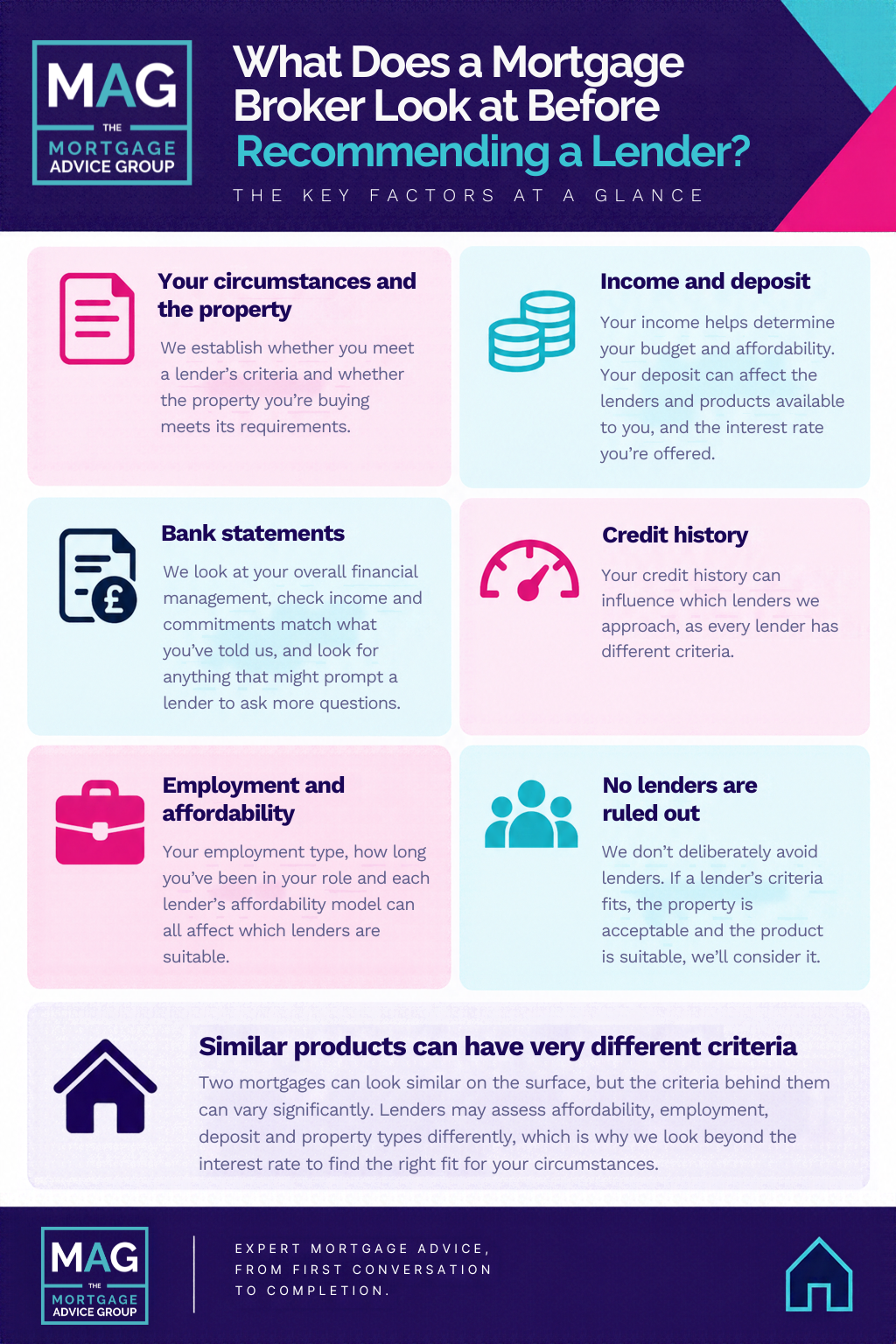
At The Mortgage Advice Group, we consider factors including your income, deposit, credit history, employment and affordability, as well as the property you’re looking to buy.
We may also review bank statements to understand how you manage your finances, confirm the information you’ve provided and identify anything a lender may ask further questions about.
Importantly, lender criteria can vary significantly. Two similar-looking mortgage products may have very different requirements, and different lenders can assess the same income or employment circumstances differently.
That’s why our research goes beyond simply finding an attractive interest rate. We look for a lender and mortgage product that fit your individual circumstances.
How do we decide which mortgage lenders to consider?
Finding a mortgage isn’t simply a case of searching for the lowest interest rate and recommending whichever lender appears at the top of the results.
Before our mortgage advisers recommend a lender or mortgage product, one of the most important things we need to establish is whether you and the property are likely to meet that lender’s criteria.
That means looking carefully at your income, deposit, credit history, employment and affordability, as well as factors relating to the property you’re looking to buy.
At The Mortgage Advice Group, we have connections with more than 70 UK lenders. But having access to different lenders is only useful if you understand which ones are appropriate for a particular customer.
Here’s what we’re looking at before we make a recommendation:
What information do we gather before searching?
Before we recommend a mortgage, we need to understand your circumstances and what you’re trying to achieve.
One of our priorities as a mortgage broker is establishing whether you meet a lender’s criteria and whether the property you’re buying meets its requirements too.
There’s little value in recommending an attractive mortgage product if, when we look more closely, the lender isn’t likely to accept your circumstances or the property.
Once we’re confident there’s a suitable match, we can consider the lender’s mortgage products and make a recommendation.
“Before we recommend a product, the most important thing is establishing whether the customer can actually get that mortgage with that lender. Do they meet the criteria, and does the property meet the criteria?”
How important are income and deposit?
Both are extremely important, although they affect your mortgage in different ways.
Your income is a major part of establishing your budget and how much you may be able to afford to borrow. Different lenders have their own affordability models, so the amount available to you isn’t necessarily identical everywhere.
Your deposit can influence both the lenders and mortgage products available to you and the interest rate you’re offered.
Generally, the percentage you’re putting down matters when we’re researching your options. Mortgages can also be available with very small deposits and, in some circumstances, without a traditional deposit, although the rate available is likely to reflect the level of deposit you’re providing.
That’s why we look at income and deposit together rather than treating either figure in isolation.
What do we look for on bank statements?
Bank statements can sometimes make customers nervous. There’s often a concern that an adviser or lender is going to scrutinise every coffee, takeaway or shopping trip.
That’s not what we’re interested in.
Our mortgage advisers are primarily looking at how you manage your income and finances and checking that the information you’ve provided is consistent with what appears on your statements.
For example, we may check that the income you’ve told us about is being received and that your financial commitments correspond with the information you’ve given us.
We’re also looking ahead to questions a lender might ask. An unexplained large payment into your account, for example, could prompt a lender to ask where the money came from. Spotting something like that beforehand gives us an opportunity to understand and account for it rather than waiting for the question to arise later.
So, a weekly McDonald’s or Zara purchase isn’t what we’re concerned about. What’s more important is the overall picture and how you’re managing the funds available to you.
How does credit history influence lender selection?
Credit history is one of the main factors we consider when deciding which lenders to research. Different lenders have different criteria, so your credit history can influence which options are appropriate for your circumstances.
Rather than choosing a mortgage based purely on the advertised rate and then discovering that the lender’s criteria don’t fit, we take your circumstances into account when carrying out our research.
This is one of the reasons why lender selection matters so much. A mortgage can look attractive on the surface, but the underlying criteria ultimately determine whether it’s a realistic option for you.
What less obvious factors affect which lenders we'll approach?
Income and deposit might be two of the most obvious considerations, but they’re far from the only ones.
Your employment circumstances can make a significant difference.
If you’re self-employed, for example, lenders can differ in how they assess your income and how long they expect you to have been self-employed. Employment contracts can matter too. Some lenders may consider applicants working on temporary contracts, while others may not.
Then there’s affordability. Every lender has its own affordability model, which means two lenders looking at the same income and circumstances don’t necessarily have to offer the same borrowing amount.
In practice, three of the biggest considerations when we’re deciding which lenders to research are:
- Your credit history
- Your employment and income
- The lender’s affordability assessment
It’s the combination of these factors that helps us narrow down which lenders may be suitable.
Are there lenders we'd deliberately avoid for an otherwise eligible client?
No. We don’t rule out a lender simply because of who they are.
Our job as mortgage brokers is to consider the options available and recommend a suitable mortgage based on the customer’s needs and circumstances.
If a lender’s criteria fit, the property is acceptable and the mortgage product is appropriate for the customer, we’ll consider it as part of our research. The focus is on finding the right fit rather than favouring or avoiding a particular lender without good reason.
How much can lender criteria differ behind similar-looking mortgage products?
A lot.
Two mortgage products can look remarkably similar when you compare their headline features, but the criteria sitting behind them can be very different.
One lender might assess affordability differently from another. Their approach to self-employed applicants may vary. Their requirements around employment contracts can differ. They can also have different criteria for the property itself. That’s why comparing mortgages purely by interest rate doesn’t tell you the whole story.
Before recommending a lender, we’re looking at both sides of the equation: is the mortgage competitive and suitable, and are the customer and property a good fit for the lender’s criteria. Having connections with more than 70 UK lenders gives us a broad range of options to research, but our role as mortgage advisers isn’t simply to present as many mortgages as possible. It’s to narrow those options down and identify a suitable mortgage based on your individual circumstances. That’s the work that happens before we ever make a recommendation.
Important information: Your home may be repossessed if you do not keep up repayments on your mortgage. The Financial Conduct Authority does not regulate all Buy to Let mortgages.

Our Locations
Prospect House, Church Green West, Redditch, B97 4DJ
301 Pershore Road South, Kings Norton, Birmingham, B30 3EX
The Mortgage Advice Group is a trading name of McTernan Financial Limited an Appointed Representative of Primis Mortgage Network, a trading name of Advance Mortgage Funding Limited which is authorised and regulated by the Financial Conduct Authority. Registered Office: Prospect House, Church Green West, Redditch B97 4DJ. Registered in England and Wales. Company number: 09168296.
Birmingham Mortgage Advice is a trading name of McTernan Financial Limited an Appointed Representative of Primis Mortgage Network, a trading name of Advance Mortgage Funding Limited which is authorised and regulated by the Financial Conduct Authority.
Redditch Mortgage Advice is a trading name of McTernan Financial Limited an Appointed Representative of Primis Mortgage Network, a trading name of Advance Mortgage Funding Limited which is authorised and regulated by the Financial Conduct Authority.
YOUR HOME MAY BE REPOSSESSED IF YOU DO NOT KEEP UP REPAYMENTS ON YOUR MORTGAGE
The Financial Conduct Authority does not regulate all Buy to Let mortgages
We charge an arrangement fee of £495 which is payable when a full application is made to a lender. Your adviser will agree your arrangement fee with you before commencing any chargeable work.
The guidance and/or advice contained within this website is subject to the UK regulatory regime and is therefore primarily targeted at consumers based in the UK.