
Mortgage Broker vs Going Direct To Bank: What Are the Differences in Practice?
One bank, or a wider range of lenders? Here’s what that difference could mean for your mortgage.
Quick Answer
A mortgage broker and a bank adviser can both help you arrange a mortgage, but there are important differences in how they work.
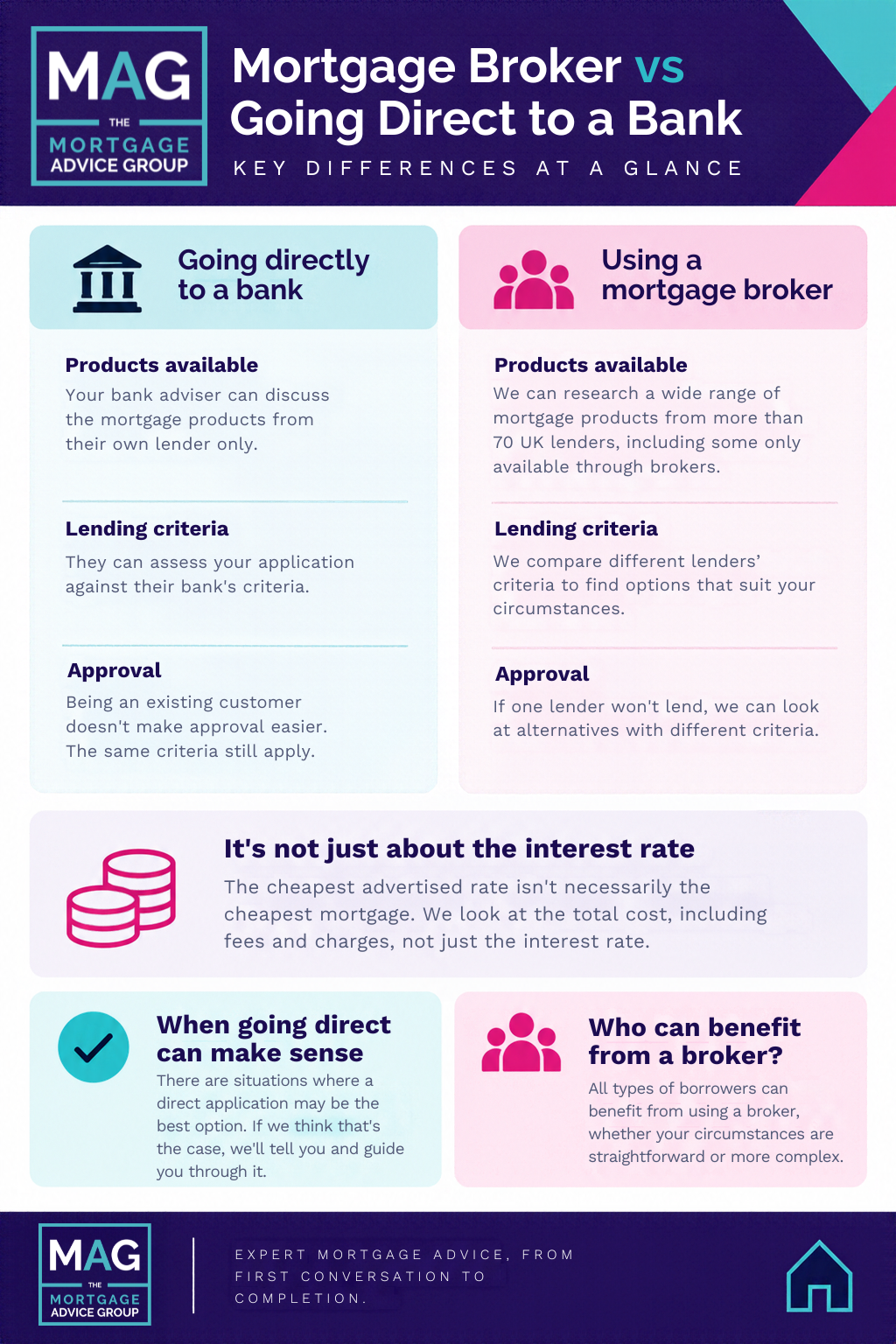
A bank adviser can discuss the products and lending criteria available from their bank, while a mortgage broker can research suitable options across multiple lenders. Some lenders and mortgage products are also only available through brokers.
Going directly to your existing bank doesn’t necessarily make approval easier, as every lender assesses applications against its own criteria.
It’s also important to look beyond the cheapest advertised interest rate. Fees and other costs can affect how much a mortgage costs overall.
At The Mortgage Advice Group, we’ll compare all options and be open about the best route for you, including telling you when going directly to a lender may make more sense.
Should you use a mortgage broker or go straight to a bank?
When you’re looking for a mortgage, one of the first decisions you might make is whether to speak to a mortgage broker or approach a bank directly.
At first glance, the difference might seem fairly small. Either way, you’re looking for a lender willing to offer you a mortgage at a competitive rate. In practice, however, the two routes can be quite different.
A bank adviser is generally discussing the mortgage products and lending criteria available through that particular bank. A mortgage broker can research across multiple lenders and products to find options that suit your circumstances. For more information on exactly what a broker does, read our previous blog post.
At The Mortgage Advice Group, we have connections with more than 70 UK lenders, giving us the opportunity to consider a much wider range of options than you would typically get by approaching one bank alone.
So, what does that difference actually mean when you’re applying for a mortgage?
What can a bank adviser discuss compared with a mortgage broker?
If you arrange an appointment directly with a bank, its adviser can discuss the mortgage products that particular lender offers and assess your circumstances against its own lending criteria.
That isn’t necessarily a problem if the bank has a suitable mortgage for you. The important distinction is the range of options being considered.
When you speak to us, we can research mortgage products from different lenders and compare their criteria against your individual circumstances.
That matters because mortgages aren’t simply about finding the lowest interest rate. We also need to establish whether you meet the lender’s criteria and whether the mortgage itself is suitable for what you’re trying to achieve.
“A bank adviser can only discuss the products and criteria available from the lender they work for. As a mortgage broker, we can look across many different lenders and products, so there’s potentially much more for us to consider.”
Does going directly to your existing bank actually make approval easier?
It’s easy to assume that your existing bank might be more likely to approve your mortgage because you already have an account with them. In practice, being an existing customer doesn’t mean you can bypass the lender’s normal mortgage criteria.
The lender still needs to assess your application against its requirements. If you don’t meet those requirements for the mortgage you’re applying for, approaching the bank directly doesn’t automatically change the outcome.
We use the lender’s mortgage application and assessment process too. If that lender isn’t prepared to offer the required mortgage based on your circumstances, applying directly isn’t necessarily going to produce a different answer.
Where working with a broker can help is in looking beyond that one lender to see whether another lender’s criteria may be more appropriate.
Why might two lenders assess the same borrower differently?
There isn’t one universal set of mortgage lending criteria.
Every lender has its own requirements, which means the same borrower can potentially receive different outcomes from different lenders.
One lender might be comfortable with a particular set of circumstances while another isn’t.
That’s one of the reasons we spend time understanding your circumstances before researching the market. Rather than simply looking for an attractive rate, we need to consider which lenders’ criteria fit your situation.
This can be particularly important when your circumstances aren’t completely straightforward. A rejection from one lender doesn’t automatically mean that every other lender will reach the same decision.
Can brokers access products consumers can't?
Sometimes, yes. There are mortgage products that are available exclusively through intermediaries such as mortgage brokers. There are also lenders whose mortgages aren’t available to customers applying directly.
Accord Mortgages is one example: its mortgage business is accessed through intermediaries rather than consumers applying directly.
That means limiting your search to mortgages you can apply for yourself could mean you’re not considering every option that may be accessible through a dedicated mortgage broker.
Is the cheapest advertised rate necessarily the cheapest mortgage?
No.
The interest rate is an important part of comparing mortgages, but it isn’t the only cost you need to consider. A mortgage with a very low advertised rate could come with additional costs associated with setting it up. Depending on the product, these might include arrangement or product fees and other charges.
When we’re sourcing and comparing mortgages, we therefore don’t simply put the lowest interest rate at the top of the list. We look at the total cost of the product, taking the relevant fees and charges into consideration alongside the interest rate. Read more about what our brokers do behind the scenes for more information.
A slightly higher rate with lower fees, for example, could potentially work out differently overall from a lower-rate product carrying larger fees.
Looking beyond the headline percentage helps us make a more meaningful comparison between the options available.
When might going direct actually make sense?
There are situations where going directly to a lender can make sense, and if we believe that’s the better route for you, we’ll tell you.
Sometimes we may identify a solution that is only available by approaching a lender directly. In that situation, we’re not going to recommend an alternative simply because it allows us to arrange the mortgage ourselves. We’ll be open about the options.
If we think you’ll get a better solution by going direct, or there’s an appropriate option that we can’t access for you, we can explain that and point you in the right direction.
We can still provide guidance and information to help you understand what you need to do next. For us, mortgage advice should be about helping you find the best route forward, even when that means telling you that you don’t need us to arrange the mortgage.
Which types of borrowers benefit most from using a broker?
Put simply: All of them.
That’s not because every borrower will ultimately need a broker to arrange their mortgage. As we’ve explained above, there are circumstances where going directly to a lender can be a perfectly sensible option. The benefit comes from understanding what your options are before making that decision.
For somebody with straightforward circumstances, that might mean comparing different lenders, products, rates and costs rather than automatically choosing their existing bank.
For someone whose circumstances are more complicated such as someone self-employed, comparing lender criteria can become even more important. What one lender won’t accept, another potentially might.
A broker can bring those different considerations together: understanding what you’re trying to achieve, researching lenders, comparing criteria, considering the total cost of suitable products and explaining the available routes.
And once we arrange a mortgage for you, our involvement doesn’t end when the application is submitted. At The Mortgage Advice Group, your application is passed to a dedicated case manager, who can help progress your case through the mortgage and legal process until completion.
Ultimately, the question isn’t simply whether a mortgage broker is better than a bank.
It’s about understanding the practical difference between asking one lender what it can offer you and researching suitable options across a much wider range of lenders.
Important information: Your home may be repossessed if you do not keep up repayments on your mortgage. The Financial Conduct Authority does not regulate all Buy to Let mortgages.

Our Locations
Prospect House, Church Green West, Redditch, B97 4DJ
301 Pershore Road South, Kings Norton, Birmingham, B30 3EX
The Mortgage Advice Group is a trading name of McTernan Financial Limited an Appointed Representative of Primis Mortgage Network, a trading name of Advance Mortgage Funding Limited which is authorised and regulated by the Financial Conduct Authority. Registered Office: Prospect House, Church Green West, Redditch B97 4DJ. Registered in England and Wales. Company number: 09168296.
Birmingham Mortgage Advice is a trading name of McTernan Financial Limited an Appointed Representative of Primis Mortgage Network, a trading name of Advance Mortgage Funding Limited which is authorised and regulated by the Financial Conduct Authority.
Redditch Mortgage Advice is a trading name of McTernan Financial Limited an Appointed Representative of Primis Mortgage Network, a trading name of Advance Mortgage Funding Limited which is authorised and regulated by the Financial Conduct Authority.
YOUR HOME MAY BE REPOSSESSED IF YOU DO NOT KEEP UP REPAYMENTS ON YOUR MORTGAGE
The Financial Conduct Authority does not regulate all Buy to Let mortgages
We charge an arrangement fee of £495 which is payable when a full application is made to a lender. Your adviser will agree your arrangement fee with you before commencing any chargeable work.
The guidance and/or advice contained within this website is subject to the UK regulatory regime and is therefore primarily targeted at consumers based in the UK.